The U.S. Court of Appeals for the Federal Circuit recently issued its decision in Enanta Pharmaceuticals, Inc. v. Pfizer, Inc., No. 2025-1427 (Fed. Cir. June 23, 2026) holding that Enanta’s U.S. patent was not entitled to the filing date of an earlier-filed provisional application because the provisional did not provide adequate written description support for the later-claimed subject matter. The deficiency, which ultimately resulted in invalidation of the issued patent, arose from a seemingly minor discrepancy between the provisional and non-provisional applications: the scope of “substituted” in the non-provisional application included “NHC(O)-C1-C12-alkyl,” but the term was more narrowly defined in the provisional as “NHC(O)-C2-C12-alkyl.” The decision highlights that a valid priority claim requires that the cited priority document (e.g., provisional application) satisfy the written description requirement.
As discussed below, applicants should strive to make provisional applications as complete and accurate as practicable, rather than relying on the non-provisional application to address shortcomings, because entitlement to priority depends on the written description contained in the provisional application.
Background
Enanta Pharmaceuticals filed U.S. Provisional Patent Application No. 63/054,048 (“the ‘048 provisional”) on July 20, 2020, directed to antiviral compounds. In the ‘048 provisional, substituent “A” was defined to include an “optionally substituted C1-C8 alkyl,” where the definition of “substituted” in the specification included the moiety “-NHC(O)-C2-C12-alkyl.”
On July 9, 2021, Enanta purportedly recognized that the reference to “C2” was a typographical error and should have read “C1.” On July 19, 2021, Enanta filed a non-provisional application claiming priority to the ‘048 provisional, revising the definition of “substituted” to include “-NHC(O)-C1-C12-alkyl.” After several continuation applications, the non-provisional ultimately issued as U.S. Patent No. 11,358,953 (“the ‘953 patent”).
On April 6, 2021, Pfizer publicly disclosed nirmatrelvir, the active ingredient in Paxlovid®, which embodies a C1 alkyl substituent (i.e., CF3) at the corresponding position.
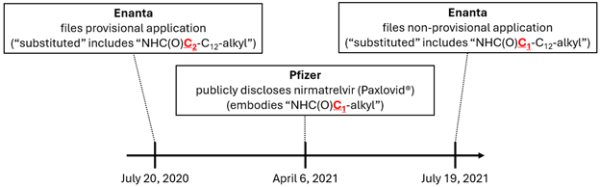
In June 2022, Enanta sued Pfizer, alleging that Pfizer’s Paxlovid® infringed the claims of the ‘953 patent, and Pfizer counterclaimed that the ‘953 patent was invalid. Pfizer asserted that, because Enanta’s ‘048 provisional did not contemplate compounds containing the newly added -NHC(O)-C1 alkyl substituent, the asserted claims of the ‘953 patent were entitled only to the later non-provisional filing date, rendering the claims anticipated by Pfizer’s intervening disclosure.
The district court agreed with Pfizer, concluding that the alleged typographical error could not be judicially corrected to preserve priority, and entered summary judgment of invalidity. Enanta appealed.
The Decision
The Federal Circuit affirmed the district court’s decision but clarified the proper analytical framework. The Court explained that the relevant inquiry was not whether the provisional application contained an obvious typographical error that could be corrected. Rather, the question was whether the provisional application satisfied the written description requirement for the later-claimed subject matter, as required for entitlement to priority.
Applying established written description principles, the Court emphasized that the provisional expressly defined the term “substituted” to include “-NHC(O)-C2-C12-alkyl,” whereas the asserted claims encompassed compounds containing “-NHC(O)-C1-C12-alkyl.” Although Enanta argued that another portion of the specification suggested the “C2” was “likely” a drafting mistake, the Court concluded that those arguments related only to a separate, general definition of “alkyl” and did not provide written description support for the specific substituent at issue.
The Court further explained that written description requires disclosure of the claimed invention itself. Because the provisional application never described compounds containing the C1 substituent, no reasonable factfinder could conclude that the written description requirement was satisfied. To illustrate the point, the Court analogized that disclosure of ethanol (a C2 alcohol) would not provide written description support for methanol (a C1 alcohol). Although the difference between the two compounds is only a single carbon atom, disclosure of one chemical species does not provide written description support for a different species merely because the structural difference appears minor. As the Court succinctly stated, “C2 is simply different from C1.”
Accordingly, the Federal Circuit held that the asserted patent was not entitled to the provisional application’s filing date. Because Pfizer’s public disclosure occurred before the effective filing date of the asserted claims, that disclosure constituted anticipatory prior art against the Enanta patent, and summary judgment of invalidity was affirmed.
Guidance for Applicants
Carefully Review Provisional Applications Before Filing
Even seemingly minor typographical or drafting errors can have significant legal consequences if they affect the scope of the disclosed invention. Applicants should carefully review chemical formulas, sequence listings, numerical ranges, and definitions of variable substituents before filing, particularly for embodiments of commercial interest. If arriving at a particular compound requires interpreting the meaning of a term (e.g., “optionally substituted”), ensure that the desired substituents can be arrived at by the definitions provided.
Treat Provisional Applications as Substantive Patent Filings
This decision reinforces that entitlement to priority depends on whether the provisional application satisfies the written description requirement. The practical takeaway is simple: applicants cannot obtain priority to subject matter that was not disclosed in the provisional application. Provisional applications are often filed under tight deadlines, but applicants should treat them as the foundation for any later priority claim. If a provisional application contains only a preliminary disclosure intended to secure a filing date ahead of a public disclosure (e.g., PhD defense), applicants should promptly follow with a more complete provisional application rather than wait until filing the non-provisional to address shortcomings. A later-filed non-provisional is entitled to the earlier filing date only to the extent its claims are adequately supported by the provisional disclosure, and later amendments or corrections cannot retroactively supply written description support that was absent at the time of the priority filing.
Correct Errors Promptly, But Recognize Their Limits
Although the Federal Circuit’s decision ultimately turned on the written description requirement rather than judicial correction of an error, the Court reiterated that mechanisms exist to correct obvious mistakes in issued patents. For example, the USPTO may permit correction through reissue under 35 U.S.C. § 251, provided the correction does not introduce new matter and the error would be considered obvious to a person of ordinary skill in the art. Likewise, a district court may correct an error by construction only where the proposed correction is not subject to reasonable debate based on the patent itself and the prosecution history does not support a different interpretation. These correction mechanisms are intentionally narrow and should not be viewed as a substitute for a complete and accurate disclosure at the time of filing.
Conclusion
Enanta is a reminder that entitlement to priority depends on satisfying the written description requirement at the time of the priority filing. The decision underscores the importance of accurate and complete provisional applications, as later amendments or corrections may not cure deficiencies in the original disclosure or preserve an earlier priority date.