What You Need to Know
- The new CEQ guidance modifies prior guidance issued on February 19, 2025, and contains a new directive: prioritizing efficiency and certainty over any other NEPA policy objective.
- The guidance professes to not be mandatory but suggests federal agencies must follow CEQ directives and states no CEQ consultation will officially be concluded until CEQ has notified the agency that its changes are approved.
- State NEPA implementing procedures may deviate from federal ones and should also be monitored for developments.
On January 20, 2025, President Donald Trump signed Executive Order 14154, which directed the Council on Environmental Quality (CEQ) to propose rescinding all of its existing regulations as to the National Environmental Policy Act (NEPA). CEQ did just that in February 2025, and concurrently issued a new memorandum as to how federal agencies should interpret NEPA. On September 29, 2025, CEQ issued a new memorandum ("New Guidelines"), replacing its prior memorandum.
The CEQ's February 2025 memorandum contained guidelines for federal agencies to consider when revising NEPA-implementing procedures. The New Guidelines replace the February 2025 guidelines with a separate document: a 23-page Agency Procedures Template.
The template states that its provisions are not mandatory or binding on federal agencies. However, the CEQ will inform a federal agency that its consultation with CEQ is "concluded" only if that agency's proposed revisions are satisfactory to the CEQ. The guidelines do not specify what particular language the CEQ will be looking for from agencies, but the underlying premise is plainly stated: the new procedures "need not restate the text of NEPA," but must prioritize "efficiency and certainty over any other policy objectives."
As "prioritizing efficiency and certainty over any other policy objectives" is not the intent of NEPA, this places federal agencies in a challenging position. First, they are required by 42 USC 4333 to "review their present statutory authority, administrative regulations, and current policies and procedures for the purpose of determining whether there are any deficiencies or inconsistencies therein which prohibit full compliance with the purposes and provisions of" NEPA. As NEPA was last amended by Congress in 2023, any procedure that was consistent with NEPA in 2023 would still satisfy "present statutory authority."
Regarding administrative regulations, CEQ eliminated all of its administrative regulations with respect to NEPA in February 2025, previously found at 40 CFR 1500 et seq. For this reason, a federal agency reviewing its current procedures might easily conclude that they satisfy the "intent, purposes, and procedures" set forth in NEPA, and thus the agency meets the requirements of 42 USC 4333.
Second, federal agencies must comply with 42 USC 4332(B), which requires them to "identify and develop methods and procedures, in consultation with the [CEQ], which will ensure that presently unquantified environmental amenities and values may be given appropriate consideration in decision-making along with economic and technical considerations." A CEQ sign-off is not required for a federal agency to implement a NEPA-implementing procedure, but New Guidelines suggest that the CEQ will decline to state that an agency's consultation with it is complete otherwise. Because the New Guidelines suggest that CEQ will agree to procedures only if they prioritize "efficiency and certainty over any other policy objectives," federal agencies may feel they must balance their obligation to comply with NEPA against the risk of not "consulting to conclusion" with the CEQ.
In the New Guidelines, the CEQ recommends conducting an initial consultation prior to implementing any interagency or public rulemaking process. The CEQ consultation process is summarized in Figure 1 below.
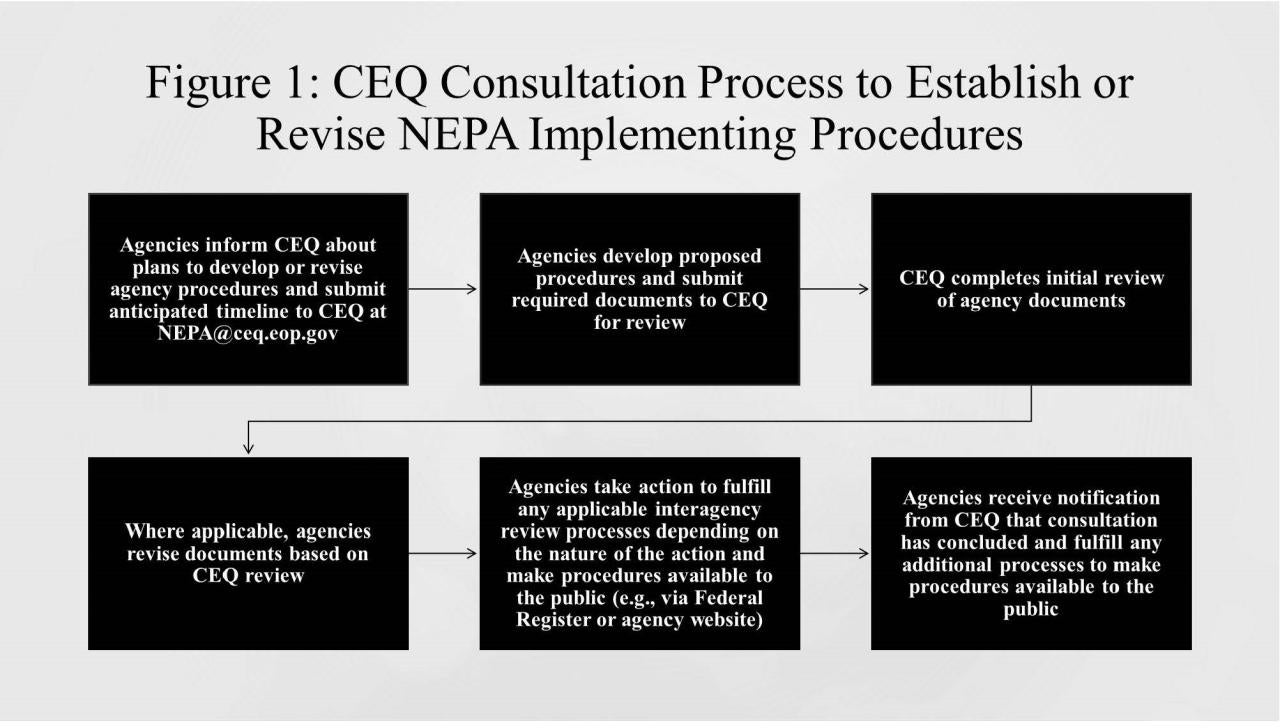
CEQ will not initiate review of documents unless all required elements are submitted.
The documentation required to initiate consultation with CEQ varies depending on the type of action an agency is enacting to revise or establish NEPA implementing procedures. Table 1 lists the requirements for rulemaking and non-rulemaking actions as well as categorical exclusions.
Table 1: Documentation Required for Rulemaking Actions, Non-Rulemaking Actions, and Categorial Exclusions
| Rulemaking Action | Non-Rulemaking Action | Categorical Exclusion |
| Submissions must include formatted Federal Register notice for Notice of Proposed Rulemaking, Interim Final Rule, or other type of rule | Submissions must include complete text of proposed NEPA implementing procedures | Submissions must include a written record containing information to substantiate agency's determination that category of actions normally do not significantly affect quality of the human environment |
| Notice should include preamble summarizing action taken and proposed regulatory text | CEQ recommends that agencies draft Federal Register notice stating availability of agency's procedures and where procedures can be accessed | For actions involving removal of existing categorical exclusions, agency should develop a written explanation for removal |
| For removal of regulations, agency must prepare Federal Register notice rescinding existing regulations | If agency elects to publish Federal Register notice, it should include draft of notice in its submission to CEQ | Packages for CEQ review must contain the appropriate formatted Federal Register notice signaling that the agency is establishing, revising, or removing categorical exclusion |
The Environmental Group at Saul Ewing will track developments on federal and state NEPA implementing procedures as they arise. Please do not hesitate to contact the authors of this alert, or your regular Saul Ewing point(s) of contact, with any questions about the substance of this alert.